
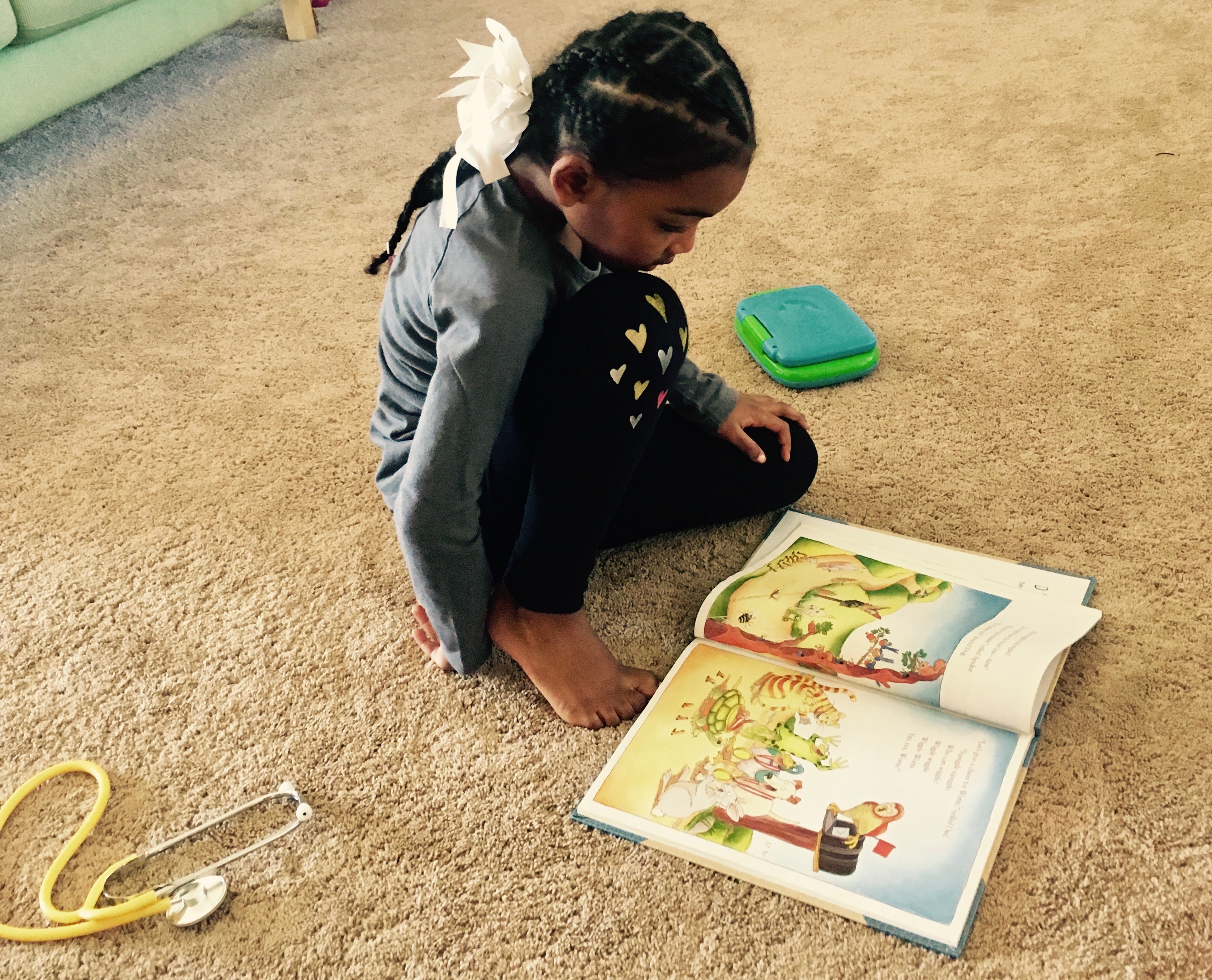
One spring morning, my 5 ½ year-old daughter walked out of her bedroom with a curious smile on her face. She had been in there for quite some time. She walked towards me and proclaimed with a huge gasp: “I’m addicted to reading!” I was so thrilled and could completely relate to her exuberance. I felt like she and I were totally on the same page and that she’d hit a real hallmark in her development. So I responded: “Hey! I’m addicted to reading TOO!!”
As I think about that day, I delightfully remember my own childhood home. Books on almost every subject littered the house. My mom loved to learn and my dad was a lifelong learner as well. So through their example, this love for reading and learning was passed on to me and now to my own children.
It’s amazing how the way our parents raised us influences how we raise our own children. Whether it is something that was really awesome we want to try with our own kids or if it’s the mistakes we are careful not to repeat. The way you were parented plays a part in how you parent your children.
I’m so thankful my parents encouraged me to be a lifelong learner. This is one of the many things that I’m glad to pass on to my children. However, there are other things that I don’t wish to pass on. I think this is true for most of us.
So, the question is, do you know your parenting style and can you clearly identify how it may help or hinder your child in developing emotional intelligence? Self- awareness is the first step in powerful transformation so let’s dig in!
Parenting Styles

We’ve all had our share of times where we’ve lost it as parents. But we want to trend toward a parenting style that will bring the best out in our child.
There are different ideas of parenting styles, but I like to draw on the research from psychologist Dr. John Gottman who identified 4 main types from his book Raising an Emotionally intelligent Child. This is a paraphrased excerpt from his book.
1. The Dismissing Parent
This parent treats the child’s emotion as a nuisance, trivial, or something that just takes time to blow over. They generally ignore the child’s emotions and believe the emotions will just blow over or work it self out somehow.
Effect on Child: The child distrusts their feelings and may have a hard time regulating their emotions.”
2. The Laissez-Faire Parent
“Acknowledges the child’s emotions, but accepts all expressions of those emotions as valid, including hitting or however the child wants to express themselves. This kind of parent consoles the child in negative feelings, but doesn’t offer alternative ways of expressing themselves. They have a hard time setting limits on their child’s behavior or offering guidance.
Effect on Child: The child has a difficult time forming friendships, being able to concentrate, and regulate their emotions.”
3. The Disapproving Parent
“This is the parent who does not respect the child’s feelings and responds to them with harshness or severe criticism. They may keep the child from expressing any form of anger or upsetting emotion and tend to be harsh with punishment as well.
Effect on the Child: The same as the dismissing parent. (The child distrusts their feelings and may have a hard time regulating their emotions)”
So these are the 3 parenting styles that when taken to the extreme can be very harmful to your child. While we may generally identify with one or another, we don’t want to imitate the extreme versions of what this looks like all of the time. Dr. Gottman discovered the 4th parenting style that measures above all the rest. He named it, the “Emotion Coach.”
The Emotion Coach

So here is a quick background of how Dr. Gottman identified this idea of the Emotion Coach. He conducted a longitudinal study at the University of Washington on how couples related to each other and their children. The research participants began the study when their children were 5 and checked back when they were 9. The children who fared the best on variety of domains had parents who had specific characteristics.
He called these parents, “Emotion Coaches.” These were parents that interacted with their children in a way that set up the right conditions for their kids to become emotional intelligent. So imagine for a moment what this looks like…
- This is the kind of parent who regularly responds to their child’s emotions with warmth and understanding as opposed to contempt and harshness.
- They are aware of their own emotions and therefore find it easier to help their child work with theirs.
- They value being able to take time and actually understand what exactly is upsetting their child.
- They are proactive in directing the child to express their emotions in healthy ways and provide reasonable alternatives to unhelpful behaviors.
- They teach ways the child can learn to soothe themselves when their upset.
- They teach appropriate emotional responses by modeling these behaviors with others and by coaching the child on how to handle their own upsetting emotions.
In essence, they are highly aware of how to be emotional intelligent themselves so they are better equipped to be able to help their children with honing in on their emotional skills. Those skills include: “learning how to recognize, manage, and harness their feelings, empathizing, and handling the feelings that arise in relationships.” (Emotional Intelligence p. 191.)
Doesn’t this sound like the kind of parent you want to be most of the time?
Major Research Findings
Now, I can go on and on about how this parenting style benefits the children, but in Daniel Goleman’s book Emotional Intelligence he summarizes the major research findings:
- Relationships with parents: “Kids get along with, show more affection toward and have less tension around their parents.”
- Coping strategies: “They’re better at handling their own emotions and are more effective at soothing themselves when upset and get upset less often.”
- Biological effects: “Their children are more relaxed biologically, they have lower levels of stress hormones and other physiological indicators of emotional arousal
- Socially: “Socially they are more popular with and more liked by their peers and seen by their teachers as more socially skilled. Their teachers rate them with fewer behavioral problem such as rudeness or aggressiveness.”
- Cognitively: “Cognitively, they can pay attention better and are more effective learners.”
Why this Matters

Being familiar with the different parenting styles isn’t meant to cause shame or embarrassment to the shortcomings you may already feel you have. However, it can be helpful to know for several reasons:
1. You’ll have a clear goal in mind.
It’s nice to have a clear vision of what an ideal parent looks like for you. Knowing clearly where you are gives you a worthy goal to aim for. When you know your parenting style you’re better able to understand which areas you need to work on as a parent. If you recognize you have tendency towards dealing with your child in a harmful manner, then you can hone in on addressing that specific aspect in your parenting.
For example, I tend to be a mix of all the parenting styles. However, I lean towards dismissing and disapproving, so I try my best to be aware of my own triggers so I can better guide my own children with their upsetting emotions instead of snapping.
I’m not saying that we will be able to control the behavior of our kids at all times or manufacture their emotions based on how we treat them or control how they behave. But we can learn how to create an environment for them to flourish in their emotions.
2. It leads to productive self-reflection.
In the process of identifying your parenting style, you may reach back into your own childhood and reconcile certain baggage you’ve had about how you were parented. It can be a painful process, but one that has to be done. It may seem unnecessary to address this in adult life, but self-understanding is key in being able to understand and empathize with others, including yourself and your children.
I recently had an insightful discussion with a friend whose parenting style is entrenched in Eastern European culture, which in her case leaned towards dismissing and disapproving. Recognizing how her parenting style affected her American born stepchildren helped her gain a deep understanding why there was so much conflict in her home.
3. It builds empathy.
Once we’ve reflected on our own childhood experiences, it’s easier to look at our children and imagine what they are going through. When we look at this in a spiritual sense, I believe that our degree of love for our children, family, and spouses is a reflection of our understanding of how much God loves us. We can give grace and love in profound ways once we receive and feel grace and love from a higher source.
Many times it is deep rejection or conditional love that we felt in our early years that have led us to parent in a way that squelches emotional expression. Embracing grace helps us to give grace more freely, which then leads us to better empathize with our children.
4. You’ll help your child out in the long run.
You’ll be on your way to avoiding the harmful long-term effects of bad parenting. As we’ve seen, there are so many benefits for the child with parents who are emotionally intelligent. It’s just like how we think of money for it’s long-term value, we ought to do the same with our children. Our positive emotional investments in them now will yield positive returns in the future.
Simple Ideas to Try

Here are some things you can try right away:
- Make a list of things you liked and didn’t like about how your parents raised you. Then, take a moment to reflect on how it may influence your own parenting for the better or worse.
- Ask God to heal you from the wounds of being parented in a way that makes it difficult to effectively handle yours and now your child’s healthy emotional development
- Do a diligent soul searching of the areas you need to improve. Allow God to reveal those things to you and come up with specific strategies to address it.
- Think of a warm yet firm parent and imitate how they may handle the next difficult situation you face with your child.
- Show gratitude by journaling, self-talk, or by expressing with your words when you see positive changes in yourself or your child. As you pay attention more, you’ll start to notice the positive changes more.
“Fathers, do not provoke your children, lest they become discouraged.”
(Colossians 3:21)

Remember that your behavior and style as a parent affects your children in profound ways. Try some of these ideas and by God’s grace you’ll be on your way to becoming the parent that God intended for you to be.
In the next post we’ll talk about the specific skills you’ll need to practice in building emotional intelligence in your child. For those of you who love specific “how-to’s” you’ll love it!
Now a question for you: What are some cool things your parent did that have influenced you growing up? Do share in the comments below.